

• 1800120400400
  • 9044266522
  • This email address is being protected from spambots. You need JavaScript enabled to view it.

Blogs

WhatsApp Business API for E-commerce: How Indian Online Businesses Are Winning with WhatsApp

India's e-commerce market is one of the fastest-growing in the world — driven by hundreds of millions of first-time online shoppers, the explosion of quick commerce, and the rapid expansion of direct-to-consumer (D2C) brands. Yet for every business gaining ground, there are common friction points that cost revenue: unanswered order queries, high cart abandonment, failed COD verification, and customer frustration with impersonal order update emails that go unread.

WhatsApp Business API is transforming how Indian e-commerce businesses communicate with their customers — bringing the entire order lifecycle into the channel where customers are already active, engaged, and responsive. From order confirmation and COD verification to delivery tracking and post-purchase reviews, WhatsApp is becoming the primary communication layer for India's most successful online businesses.

In this guide, we cover the most impactful WhatsApp Business API use cases for Indian e-commerce — and explain how Muzztech's official Meta Business Partner platform helps online businesses implement them fast.

Why WhatsApp is the Perfect Channel for Indian E-commerce

The case for WhatsApp in e-commerce is built on a simple insight: your customers already use WhatsApp constantly — it is the app they open dozens of times a day, the channel they trust, and the one they respond to fastest. When your order updates, delivery notifications, and support conversations happen on WhatsApp, they feel personal and immediate rather than automated and corporate.

  • Open rates above 90% vs 15–25% for email: Order confirmations, shipping alerts, and promotional messages sent via WhatsApp are almost universally read — ensuring your customer is always informed.
  • Two-way conversations: Unlike SMS or email, WhatsApp enables customers to reply, ask questions, raise concerns, and complete actions — all within the same conversation thread.
  • Rich media support: Product images, order summary cards, delivery location maps, and payment links can all be sent within a WhatsApp message — making every notification richer and more actionable than a plain text SMS.
  • Trusted channel: Verified businesses display their brand name and logo — so customers immediately recognise who they are hearing from and trust the communication.

Use Case 1: Order Confirmation and COD Verification

For Indian e-commerce businesses, Cash on Delivery (COD) remains a dominant payment method — accounting for a significant portion of all orders across most categories. But COD orders have a major problem: high return-to-origin (RTO) rates, where the customer is not available or refuses delivery. Unconfirmed COD orders cost businesses money in logistics, inventory holding, and re-shipping.

WhatsApp solves this with automated COD confirmation flows. Immediately after a COD order is placed, a WhatsApp message is sent to the customer with their order summary and two interactive buttons: "Confirm my order" and "Cancel order". This simple step:

  • Reduces RTO rates by filtering out unintentional or fraudulent orders before they are even dispatched
  • Verifies the customer's phone number is active and connected to WhatsApp
  • Creates a documented confirmation trail for dispute resolution

Indian e-commerce businesses using WhatsApp COD confirmation typically report a 20–35% reduction in RTO rates — a significant direct saving on reverse logistics costs.

Use Case 2: Real-Time Order Tracking and Delivery Updates

"Where is my order?" is the single most common customer service query for any e-commerce business. Proactively answering this question through WhatsApp — at every stage of the delivery journey — dramatically reduces inbound support queries, improves customer satisfaction, and builds delivery trust.

A complete WhatsApp order tracking flow sends automated updates at every key milestone:

  • Order confirmed: A rich WhatsApp card with the order summary, expected delivery date, and a short tracking link.
  • Order dispatched: Courier name, tracking number, and an interactive button linking to the live tracking page.
  • Out for delivery: "Your order is on its way — expected between 2 PM and 5 PM today" with an option to reschedule if the time is inconvenient.
  • Delivered: A delivery confirmation with a prompt to rate the experience — capturing feedback while satisfaction is highest.

Businesses that implement proactive WhatsApp order tracking consistently report 30–50% reductions in order status support queries — freeing their customer service team for higher-value interactions.

Use Case 3: Abandoned Cart Recovery That Actually Works

Cart abandonment rates in Indian e-commerce typically range from 70% to 80% — meaning the vast majority of customers who add a product to their cart never complete the purchase. WhatsApp abandoned cart recovery consistently outperforms email and SMS for recovery rates, because the message arrives in the customer's most-used app and feels personal rather than automated.

An effective three-message WhatsApp cart recovery sequence:

  • Message 1 (1 hour after abandonment): A friendly, non-pushy reminder with a product image and a single-tap "Complete my order" button. No discount yet — many customers abandoned due to distraction and will convert without any incentive.
  • Message 2 (24 hours later, if no conversion): Add social proof and mild urgency — "Over 200 customers bought this week" or "Only 4 units left in stock" — with the product image and checkout button.
  • Message 3 (48 hours later, final): A time-limited offer — "Here's 10% off your order — valid for the next 24 hours only" — with a pre-applied discount code included in the checkout link.

Use Case 4: WhatsApp Product Catalogue for Conversational Commerce

WhatsApp's product catalogue feature — available through the Business API — allows businesses to showcase their products directly within WhatsApp. Customers can browse products, view images and prices, and add items to a cart — all without leaving the conversation. For Indian small businesses, D2C brands, and local retailers, this creates a shopping experience that requires no website or app.

Effective catalogue use cases for Indian businesses:

  • Fashion and apparel: Share new arrival lookbooks as WhatsApp catalogue messages — customers browse and tap to enquire or purchase without visiting the website.
  • Food and restaurant businesses: Display the menu as a WhatsApp catalogue — customers place orders by selecting items and confirming in the chat.
  • Wholesale and B2B: Share product lists with pricing to wholesale buyers via WhatsApp — enabling order placement through the chat with no need for a dedicated B2B portal.

Use Case 5: Post-Purchase Engagement and Repeat Sales

The customer relationship does not end at delivery — it is just beginning. WhatsApp is the ideal channel for post-purchase engagement because it feels personal, is already associated with the order journey, and has the highest open rates of any channel for follow-up communication.

High-performing post-purchase WhatsApp flows for Indian e-commerce:

  • Review request: Send 2–3 days after delivery with a one-tap rating button — capturing reviews while the purchase experience is still fresh.
  • Product care tips: For categories like electronics, clothing, or skincare — send useful care tips that add value, build expertise association, and keep your brand top of mind.
  • Cross-sell and upsell: "Customers who bought your headphones also love this carry case — here's 15% off to complete your setup." Personalised, product-relevant offers sent 7–14 days post-purchase.
  • Subscription and replenishment reminders: For consumables — skincare, supplements, pet food — send timely WhatsApp reminders when the product is due for replenishment, with a one-tap reorder button.

Use Case 6: AI-Powered WhatsApp Customer Support

A WhatsApp AI chatbot handles the most common e-commerce support queries instantly — 24 hours a day, 7 days a week — without any human involvement:

  • Order status: "Your order #45231 is out for delivery and expected by 4 PM today."
  • Return and refund initiation: Guide customers through the return process step by step — capturing return reason, initiating pickup scheduling, and processing refund requests automatically.
  • Product availability and sizing: Answer common pre-purchase questions about availability, sizing guides, and delivery timelines — reducing the friction that causes cart abandonment.
  • Live agent escalation: When the chatbot cannot resolve a query, it seamlessly transfers the conversation to a human agent — with full conversation history — so the customer never has to repeat themselves.

How Muzztech Powers WhatsApp for E-commerce

As an official Meta Business Partner, Muzztech provides Indian e-commerce businesses with authorised WhatsApp Business API access and the complete toolkit to implement every use case above:

  • Fast onboarding — go live in 3–5 business days with our guided setup process
  • Pre-built e-commerce message templates for COD confirmation, order tracking, cart recovery, and post-purchase flows
  • Shopify, WooCommerce, and Magento integrations via our Enterprise SMS API — triggering WhatsApp messages automatically from your existing platform
  • WhatsApp chatbot deployment — rule-based or AI-powered — for 24/7 customer support automation
  • Real-time analytics — delivery rates, read rates, button click-through rates, and recovery attribution — all in the Muzztech dashboard.
WhatsApp Marketing in 2026: Strategies That Actually Convert

With over 500 million active users in India, WhatsApp is not just a messaging app — it is where your customers spend a significant portion of their digital day. They share news, coordinate with family, manage group chats, and increasingly, they shop, seek support, and make decisions — all within WhatsApp. For businesses, this is not a future opportunity. It is a present reality that competitors are already capitalising on.

But WhatsApp marketing in 2026 is not simply about blasting promotional messages to a contact list. The most effective WhatsApp marketing strategies are personal, conversational, and customer-centric — leveraging the intimacy of the messaging channel to build genuine relationships and drive measurable business outcomes.

In this guide, we break down the WhatsApp marketing strategies that are generating real results for Indian businesses in 2026 — and explain how Muzztech's WhatsApp Business API platform gives you the tools to execute them at scale.

Why WhatsApp is India's Most Powerful Marketing Channel in 2026

The case for WhatsApp as a marketing channel is built on numbers that no other channel can match in the Indian context:

  • Open rates above 90%: WhatsApp messages are opened and read far more consistently than email (20-25%) or even SMS (98% for SMS, but WhatsApp messages are read within the conversational context — meaning engagement is higher and more sustained).
  • 500 million Indian users: No other messaging platform comes close to WhatsApp's penetration across urban, semi-urban, and even rural India.
  • Rich media and interactivity: Unlike SMS, WhatsApp supports images, videos, PDFs, audio, location sharing, interactive buttons, and product catalogues — enabling significantly richer brand experiences.
  • Two-way conversations: WhatsApp is inherently conversational — customers can respond, ask questions, and complete purchases within the same thread, reducing friction in the customer journey.
  • Trusted channel: Because WhatsApp is primarily used for personal communication, messages from verified businesses carry a higher trust signal than those received through other channels.

The Foundation of WhatsApp Marketing: The Business API

Effective WhatsApp marketing at scale requires the WhatsApp Business API — not the free WhatsApp Business App, which is limited to 256-contact broadcasts and manual messaging. The API, accessed through official Meta Business Partners like Muzztech, gives businesses:

  • Unlimited broadcast reach to opted-in contacts
  • Approved marketing message templates for outbound campaigns
  • Interactive message formats — list messages, reply buttons, call-to-action buttons
  • AI chatbot integration for automated conversational flows
  • Green tick verified business profile for instant credibility
  • Full API integration with CRM, e-commerce platforms, and marketing automation tools

Strategy 1: High-Converting WhatsApp Broadcast Campaigns

WhatsApp broadcast campaigns are the WhatsApp equivalent of email newsletters — but with dramatically higher open and engagement rates. Through the WhatsApp Business API, you can send approved marketing templates to your entire opted-in contact base simultaneously.

To maximise the conversion rate of your broadcast campaigns:

  • Lead with value, not a sale: Open with something genuinely useful — an exclusive early access offer, a useful tip, or personalised content — before presenting the call to action.
  • Use rich media: A short product video, a compelling image, or a visually appealing offer card outperforms plain text significantly. WhatsApp's rich media support is one of its key advantages over SMS.
  • Add interactive buttons: Include quick-reply buttons ("Claim offer", "Learn more") or call-to-action buttons ("Shop now", "Call us") to make it effortless for the recipient to take the next step.
  • Segment and personalise: Do not send the same message to everyone. Use purchase history, location, or engagement data to send relevant offers to each segment — a customer who bought running shoes should receive different content than one who bought formal wear.

Strategy 2: Conversational Commerce — Selling Inside the Chat

Conversational commerce is the practice of enabling customers to browse, enquire, and purchase without ever leaving the WhatsApp conversation. In 2026, this is one of the most powerful and fastest-growing WhatsApp marketing strategies in India — particularly for e-commerce, fashion, FMCG, and direct-to-consumer brands.

Key tactics for conversational commerce on WhatsApp:

  • WhatsApp Product Catalogue: Showcase your products directly inside WhatsApp — customers can browse, select, and enquire about items from within the chat interface without visiting a separate website.
  • AI-powered shopping assistant: Deploy a WhatsApp chatbot that recommends products based on the customer's stated preferences, budget, and past purchase history — providing a personalised shopping experience at scale.
  • Seamless payment integration: Integrate WhatsApp with payment gateways so customers can confirm and pay for their purchase directly within the conversation — reducing drop-off at the checkout stage.

Strategy 3: Abandoned Cart Recovery and Customer Retargeting

Cart abandonment is one of the biggest revenue leaks for Indian e-commerce businesses — with industry abandonment rates typically ranging from 70% to 80%. WhatsApp is proving to be the most effective channel for recovering abandoned carts, consistently outperforming email for recovery rates.

An effective WhatsApp abandoned cart strategy follows a structured sequence:

  • First message (30–60 minutes after abandonment): A friendly reminder with an image of the abandoned product and a one-tap link back to the cart — no pressure, just a helpful nudge.
  • Second message (24 hours later, if no purchase): A value-added message — social proof ("1,200 customers love this product"), a sense of scarcity ("Only 3 left in stock"), or a small incentive ("Here's 10% off, just for you").
  • Third message (48 hours later, final attempt): A last-chance message with the most compelling offer. After this, remove the customer from the cart recovery sequence to avoid over-messaging.

Beyond cart abandonment, WhatsApp retargeting allows businesses to re-engage customers who viewed specific products, lapsed customers who have not purchased in 30+ days, and customers who opened a previous WhatsApp message but did not convert — all with personalised, context-aware messages.

Strategy 4: WhatsApp as a Customer Support and Loyalty Channel

WhatsApp marketing is not just about outbound campaigns — it is also about being available for inbound conversations. Customers who can reach a business quickly and easily on WhatsApp are significantly more loyal and more likely to repurchase than those who have to navigate a phone queue or wait for an email response.

High-performing WhatsApp support and loyalty tactics include:

  • Instant order and delivery updates: Proactive WhatsApp notifications for every stage of the order journey — confirmation, dispatch, out for delivery, delivered — dramatically reduce inbound support queries.
  • Post-purchase engagement: A WhatsApp message 2–3 days after delivery asking for a rating, offering care tips for the product, or suggesting complementary purchases extends the customer relationship beyond the transaction.
  • Loyalty and reward notifications: Alert customers to their loyalty points balance, tier upgrades, and exclusive member offers through WhatsApp — driving repeat purchase behaviour.
  • AI chatbot + human escalation: Deploy a WhatsApp chatbot to handle FAQs, order queries, and return requests instantly — with seamless escalation to a human agent for complex issues, ensuring every customer gets a resolution.

Strategy 5: Building a High-Quality Opt-In List — The Foundation of WhatsApp Marketing

Every WhatsApp marketing strategy depends on one non-negotiable foundation: explicit opt-in consent. Unlike SMS, where DLT registration manages compliance at the platform level, WhatsApp requires businesses to obtain clear, documented opt-in from every contact before sending marketing messages.

Effective opt-in strategies that build high-quality WhatsApp contact lists include:

  • Website opt-in widgets: A WhatsApp opt-in checkbox or button on your website checkout, contact form, or pop-up — making it easy for engaged website visitors to subscribe.
  • Click-to-WhatsApp ads: Facebook and Instagram ads with a "Chat on WhatsApp" CTA that opens a WhatsApp conversation directly — allowing you to capture opt-ins from cold audiences at scale.
  • In-store QR codes: A QR code at the point of purchase that opens a WhatsApp conversation — particularly effective for retail, restaurant, and service businesses.
  • Lead magnets: Offer a valuable incentive — a discount, a free guide, an exclusive offer — in exchange for WhatsApp opt-in. Customers who opt in for a specific benefit are far more engaged than those who were simply added to a list.

A smaller list of genuinely opted-in, engaged contacts will always outperform a larger list of contacts who did not explicitly consent. Meta's quality rating system for WhatsApp Business accounts rewards businesses with engaged audiences — and penalises those with high block and report rates.

How Muzztech Powers Your WhatsApp Marketing Strategy

As an official Meta Business Partner, Muzztech gives Indian businesses authorised access to the WhatsApp Business API — along with the tools, support, and expertise to build and execute high-converting WhatsApp marketing campaigns:

  • Fast API onboarding: Go from zero to live WhatsApp marketing in as little as 3 business days with Muzztech's guided onboarding process.
  • Template creation and approval: Our team designs effective marketing templates and manages the Meta approval process on your behalf.
  • Campaign management dashboard: Plan, schedule, and monitor WhatsApp broadcast campaigns — with real-time delivery, read, and click-through analytics.
  • Chatbot deployment: Build and deploy AI-powered or rule-based WhatsApp chatbots for sales, support, and lead qualification — no coding required.
  • CRM and e-commerce integration: Connect WhatsApp to your existing systems via our Enterprise SMS API for automated trigger-based campaigns, order notifications, and abandoned cart recovery.
  • Unified CPaaS platform: Manage WhatsApp alongside your Bulk SMS, RCS, and IVR campaigns — with unified analytics across every channel.

WhatsApp Business API: How Muzztech Helps You Set It Up Fast

WhatsApp Business API: How Muzztech Helps You Set It Up Fast

With over 500 million active users in India alone, WhatsApp is not just a messaging app — it is where your customers already are. But while individuals use WhatsApp for free, businesses that want to communicate at scale, automate conversations, and send bulk notifications need something more powerful: the WhatsApp Business API.

The WhatsApp Business API is Meta's official enterprise-grade solution that allows businesses to send messages, automate support, run marketing campaigns, and deliver OTPs — all through WhatsApp, at scale. And unlike the free WhatsApp Business App, the API has no limits on the number of conversations or contacts.

The challenge? Accessing the WhatsApp Business API directly from Meta can be complex, time-consuming, and requires technical expertise. That is where Muzztech comes in. As an official Meta Business Partner, Muzztech simplifies the entire process — from onboarding and verification to template approval and API integration — so your business can go live on WhatsApp in days, not weeks.

What is the WhatsApp Business API?

The WhatsApp Business API (now part of Meta's Cloud API) is an enterprise messaging interface that allows businesses to programmatically send and receive WhatsApp messages at scale. Unlike the consumer WhatsApp app or the small-business WhatsApp Business App, the API is designed for medium to large businesses that need to:

  • Send transactional notifications — order updates, shipping alerts, payment receipts

  • Run marketing campaigns — product launches, offers, re-engagement messages

  • Automate customer support — AI-powered chatbots, FAQ bots, live agent handoff

  • Deliver OTPs and authentication messages — with higher open rates than SMS

  • Manage two-way conversations — at scale across thousands of simultaneous users

WhatsApp Business App vs WhatsApp Business API: What's the Difference?

Many business owners start with the free WhatsApp Business App and quickly run into its limitations. Here is how the two compare:

Scale and volume

WhatsApp Business App: Limited to one device, one user, and small contact lists.

WhatsApp Business API: Unlimited contacts, unlimited simultaneous conversations, and multi-agent support through CRM integration.

Automation

WhatsApp Business App: Basic auto-reply and away messages only.

WhatsApp Business API: Full chatbot automation, workflow triggers, and AI-powered conversational flows.

Broadcast messaging

WhatsApp Business App: Broadcasts limited to 256 contacts who have saved your number.

WhatsApp Business API: Send approved template messages to unlimited opted-in contacts simultaneously.

Integration

WhatsApp Business App: No integration with CRMs, ERPs, or other business systems.

WhatsApp Business API: Full API access for integration with any CRM, helpdesk, e-commerce platform, or custom application.

Key Features of WhatsApp Business API

When you access the WhatsApp Business API through Muzztech, you get access to the full suite of WhatsApp's enterprise capabilities:

  • Rich media messaging: Send images, videos, PDFs, location pins, and interactive buttons directly in the WhatsApp chat.

  • Message templates: Use Meta-approved message templates for notifications and marketing. Muzztech helps you design and get templates approved quickly.

  • Interactive messages: Use list messages, reply buttons, and call-to-action buttons to guide customers through automated flows.

  • WhatsApp Chatbot: Deploy AI-powered or rule-based chatbots that handle common queries, qualify leads, and escalate to live agents when needed.

  • Green tick verification: Get the official verified badge on your WhatsApp business profile, building instant trust with your customers.

  • Analytics and reporting: Track message delivery, read rates, and response times through Muzztech's unified dashboard.

Top Business Use Cases for WhatsApp Business API in India

WhatsApp Business API is used across virtually every industry in India. Here are some of the most impactful applications:

  • E-commerce: Abandoned cart recovery messages, order confirmations, delivery tracking, and post-purchase review requests — all on WhatsApp.

  • BFSI (Banking, Financial Services & Insurance): Loan application updates, policy reminders, EMI alerts, and fraud notifications.

  • Healthcare: Appointment confirmations, prescription reminders, lab report sharing, and teleconsultation links.

  • EdTech: Course enrollment confirmations, class schedules, assignment reminders, and student support bots.

  • Travel & hospitality: Booking confirmations, check-in reminders, itinerary cards, and real-time travel alerts.

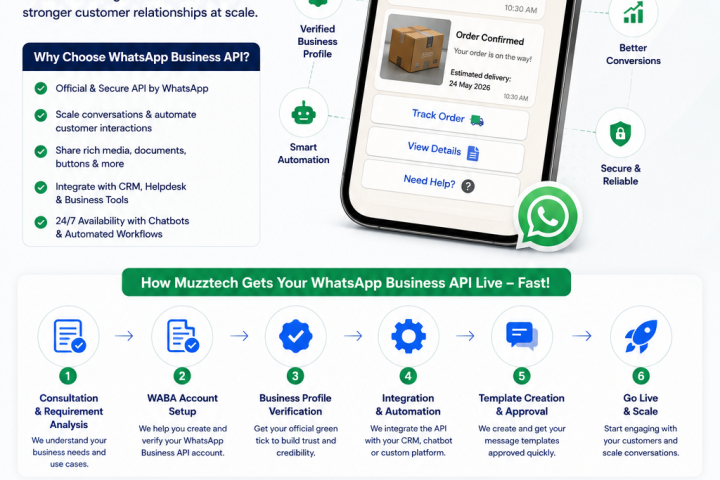
How Muzztech Sets Up WhatsApp Business API for Your Business

As an official Meta Business Partner, Muzztech has a streamlined onboarding process that gets your business live on the WhatsApp Business API quickly and compliantly. Here is how it works:

  1. Business verification: We guide you through Meta's Facebook Business Manager verification process to establish your business identity.

  2. WhatsApp number registration: We register your chosen business phone number on the WhatsApp Business API — this can be a new number or an existing one (subject to conditions).

  3. Template creation and approval: Our team helps you craft effective message templates and submits them to Meta for approval on your behalf.

  4. API integration: We provide complete API documentation and developer support for integrating the WhatsApp API into your existing CRM, ERP, or custom application.

  5. Dashboard access: You get access to Muzztech's CPaaS dashboard for campaign management, contact list management, and real-time analytics.

  6. Go live: Typically within 3–5 business days of completing verification, your business is live and sending WhatsApp messages at scale.

Why Choose Muzztech as Your WhatsApp Business API Provider?

There are many WhatsApp API resellers in India, but Muzztech stands apart for several key reasons:

  • Official Meta Business Partner: We are authorised by Meta to provide WhatsApp Business API — not a reseller of a reseller.

  • 15+ years of experience: Our team has deep expertise in cloud communications and understands the specific compliance requirements of the Indian market.

  • Unified CPaaS platform: Manage WhatsApp alongside your Bulk SMS, RCS, IVR, and email campaigns — all from one dashboard.

  • Dedicated support: A dedicated account manager and 24/7 technical support ensure your campaigns run without interruption.

  • Competitive pricing: Transparent, volume-based pricing with no hidden fees — tailored for startups and enterprises alike.


Today, WhatsApp continues to be one of the most widely used business messaging channels across the world — powering marketing campaigns, customer support, notifications, and transactional communication. As businesses scale their WhatsApp usage, Meta (WhatsApp’s parent company) regularly updates its pricing model to match market needs and ensure long-term sustainability.

The latest pricing structure has shifted how WhatsApp charges businesses — moving away from traditional per‐conversation billing and towards per-message pricing based on message categories.

Here’s everything you need to know.

What Is WhatsApp Conversation / Message-Based Pricing?

WhatsApp Business pricing determines how much you pay when communicating with customers over WhatsApp. Previously, Meta charged businesses per 24-hour conversation, regardless of how many messages were sent in that window.

In the current pricing model, Meta charges per message sent by the business, depending on the purpose and type of message — and not per conversation session.

A “conversation” still refers to a 24-hour window starting when a user or business message is exchanged, but the actual billing now depends on each template message delivered and its category.

WhatsApp’s Current Message Categories Explained

Meta groups WhatsApp business messages into four key categories — and each has its own pricing rules.

1. Authentication

Messages used to verify a user’s identity — usually during login, sign-up, password reset, or other security processes.

These are template messages containing one-time passcodes or verification codes.

Examples:
✔ “Your OTP is {{123456}} — valid for 10 minutes.”
✔ “Your verification code is {{345678}}.”

2. Utility

Messages related to transactions, confirmations, updates, or essential information.

Examples:
✔ “Your order #3213 is confirmed.”
✔ “Your payment was received.”
✔ “Your order has been shipped — expected delivery on 26th February.”

3. Marketing

Messages used for promotional activity — sales alerts, offers, product launches, reminders, and discounts.

Examples:
✔ “Get ₹500 off on your next order!”
✔ “Flash sale today — 50% discount!”
✔ “You left items in your cart — complete checkout now!”

4. Service

These are free-form customer messages where the conversation is initiated by the user, and the business responds to support questions, inquiries, or help requests.

Examples:
✔ “Hi, I want to check order status.”
✔ “Can I reschedule my appointment?”
✔ “Where is my shipment?”

How Pricing Works Today (India, 2026)?

Meta now charges per message delivered by the business, with rates varying by category. For businesses in India, current rates are approximately:

Message Type Meta Cost per Message (₹)
🎯 Marketing ₹0.8631
📦 Utility ₹0.115
🔒 Authentication ₹0.115
🤝 Service (customer initiated) Free

Note: Service messages are free as part of the active 24-hour user service window — when a user initiates the chat, and the responses are within that window.

Utility or authentication templates sent outside a customer-initiated service window are charged per message at their respective rates.

Are Free Conversations Still Available?

Yes — but under the revised pricing logic:

Service messages remain free as long as the customer initiates the conversation and responses occur within the 24-hour service window.
✔ But the old “1,000 free service conversations per month” model is outdated — today it’s tied to user-initiated windows, not a monthly quota.

Other categories (Marketing, Utility, Authentication) are always charged per message with no free tier.

What This Means for Your Business?

The shift to per-message pricing, based on message category, has some important implications:

Marketing Costs May Increase

Marketing campaigns are one of the most expensive categories. Businesses sending bulk offers must account for ₹0.8631 per message in India when planning budgets.

Transactional and Authentication Messages Are Cost-Efficient

Utility and verification messages are relatively inexpensive. Optimizing automated notifications and login flows accordingly can help control costs.

Cost Optimization Is Now More Critical

Because pricing is per message, businesses must plan segmentation, frequency, and message purpose carefully.

How We Can Help?

With the latest pricing updates, cost-effective WhatsApp campaigns demand smart planning — from template creation to message timing and engagement strategy.

Muzztech helps you:

✔ Choose the right template categories
✔ Optimize message sequences to reduce costs
✔ Improve customer journeys without overshooting budget